
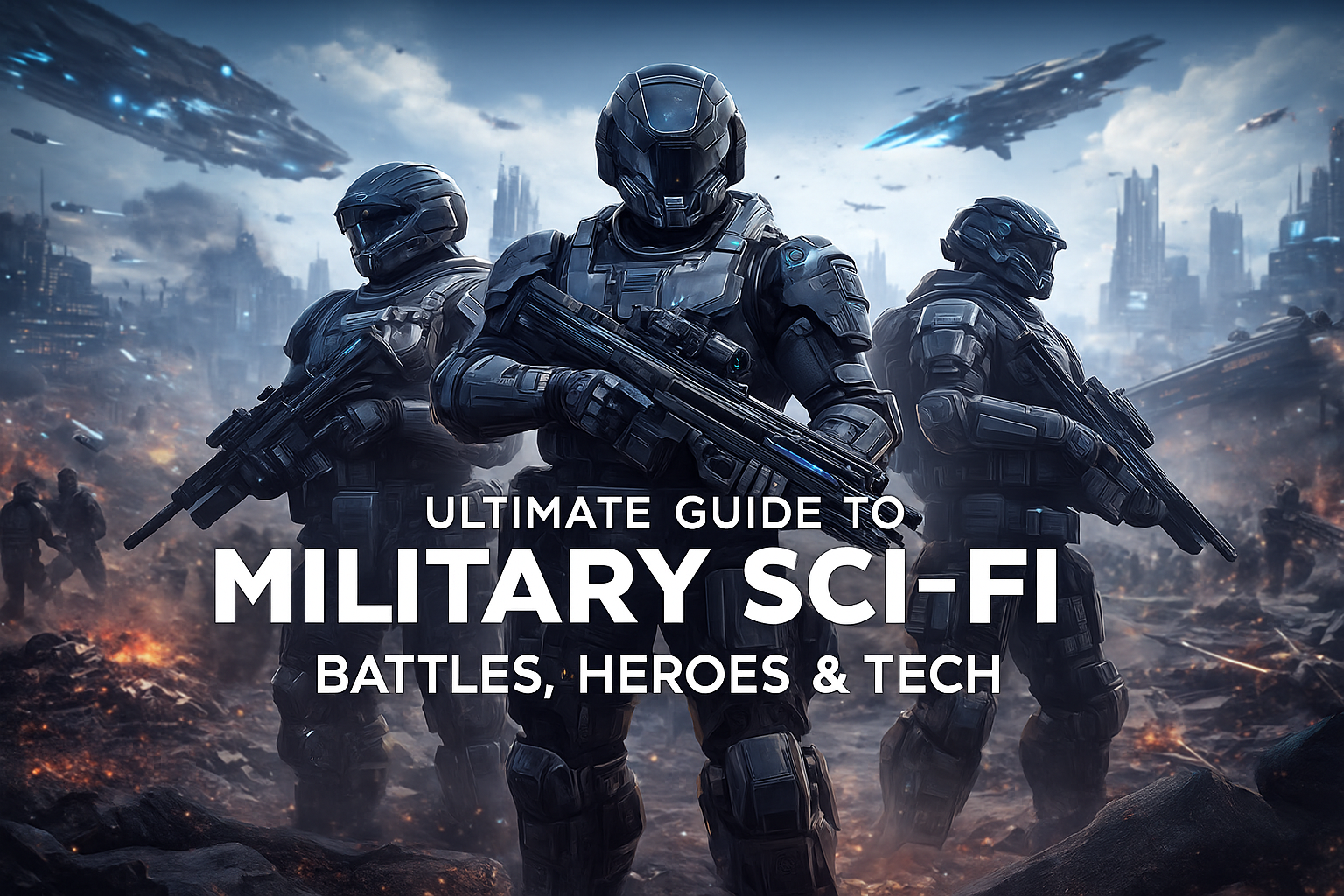
Military Science Fiction (Mil-SF) is a genre that is unique without any doubt. It exists at the explosive intersection of rigorous tactical strategy and dizzying technological possibility.
This is not just about space battles; it is about the human element of warfare transposed onto a cosmic stage where the weapons can wipe out and vaporize planets. Also, the enemy might be an enigmatic alien intelligence. Here are the elements of warfare this genre discusses:
- Command structure.
- Discipline.
- Sacrifice.
- Survival.
Is this genre a perennial favorite?
What makes military science fiction a perennial favorite is its ability to explore the profound philosophical questions regarding humanity’s role in the universe through the high-stakes lens of combat.
For readers, the thrill lies in the authentic detail: understanding the loadout of a powered armor suit, calculating a railgun’s firing solution, or appreciating the tactical brilliance of a naval commander fighting a four-dimensional battle across light-years.
However, it should be understood that a poorly written Mil-SF novel can ignore such technical and tactical demands that result in shallow action.
How can this blog post help?
This blog post will serve as the complete guide on the essential elements of the genre. It will briefly explore the iconic archetypes (ranging from grizzled marines to exceptional tacticians), dissect the foundational technologies that define military science fiction.
Briefly Understanding The Key Elements of Military Sci-Fi: Battles, Heroes, and Technology
Military science fiction explores warfare in futuristic settings, blending realistic military principles with speculative technology to examine the human element amidst large-scale conflict.
The genre is a dynamic subgenre captivating readers with epic interstellar battles, compelling narratives of military personnel, and advanced weaponry. It uses a speculative lens to explore the enduring themes and ethical complexities of conflict between aliens and humans. Here are the key elements of the genre found in any Military Science Fiction Book:
Futuristic military technology
The genre heavily features advanced weaponry, vehicles and systems that push the boundaries of existing capabilities. Here are some common examples:
- Powered armor and exosuits: They amplify soldiers’ strength and protection.
- Space forces and starfighters: Detailed descriptions of large fleets and kinetic weapons.
- AI and Drones. Using artificial intelligence in command structures and autonomous combat units.
- Super soldiers: Genetically engineered or technologically augmented soldiers usually work as protagonists.
Realistic military structures and tactics
The setting is indeed futuristic. The operational framework can usually be grounded in either contemporary or historical military organizations, which are complete with a clear chain of command, jargon, and logistics.
The perspective of a soldier
Beyond grand strategy, military science fiction usually focuses on the individual combat experience. It explores themes of friendship, sacrifice, trauma, and the psychological toll of war.
Philosophical and ethical questions
The genre provides a platform that addresses complex ideas about the nature of conflict, the morality of military actions, and the impact of war on society. It can serve as social or political commentary.
Important tips on writing military science fiction
Writing a worthwhile military science fiction novel is a long and challenging process. As with any novel, authors need to make a satisfying plot, develop interesting characters, and write polished and vivid prose.
That being said, Military Science Fiction Book Publishing and writing have unique considerations, and they are as under:
Establish a Sophisticated Central Premise
A worthwhile military science fiction narrative needs to be built around a strong and refined concept. It has multiple ‘what if’ scenarios. Authors need to articulate the fundamental philosophical question their novel must address. It serves as the main point for the whole plot.
The core concept may ask about the moral limits of deploying genetically modified soldiers to war. Another one may question the impact of the proliferation of Alien AI compromising a military command structure.
Develop a Narrative That Matters.
A military science fiction novel is inherently an intellectual exercise in world-building and strategy. Yet, its thought experiment must be an engaging story in the authentic sense. Authors must craft a compelling plot that thoroughly explores the central premise.
Crucially, define the specific change either a dramatic transformation in the sociopolitical landscape or a deep, internal evolution within the main character that occurs as a direct consequence of the story’s events. The stakes must be personal as well as planetary.
Construct a Highly Detailed and Relevant World
A highly detailed and relevant world is the key to earning credibility in the genre. Each technological detail, political faction and social norm needs to be imagined nicely. These elements must extend from the narrative logically.
Whether it is the protocol of an intergalactic agreement or the design of a kinetic weapon, it must reflect the author’s critique or commentary on real-world military and political issues.
Maintain Ironclad Consistency in World Rules
Military science fiction stories should have a good amount of logic. It is not like fantasy because the tactical rules and technology need to be consistent and regulated throughout the story and its narrative. Authors must define the limits and capabilities of advanced weapons, starship movement, and any laws present.
If authors do not follow these self-imposed rules, then they will break the reader’s reading flow. They will undermine the needed realism for military credibility.
Prioritize Deep Character Conflict
It can be easy to get absorbed in the grandeur of ships maneuvering and all the futuristic technology making wonderful inventions and producing results. But the sacrifice of the individuals fighting the war out there should not be forgotten.
This is where authors must ensure that each of the characters possesses complex and relatable motivations. Even the internal conflicts should be as interesting as the external ones.
The plot can hinge on winning a massive campaign. Yet the reader’s engagement hinges on the character’s personal struggles, sacrifices, and transformation arcs within the military environment.
Conclusion
Military science fiction novels and stories can remind many of Star Trek, Starship Troopers, Farscape, and Stargate SG-1. Star Wars is also another famous name in the genre that has a very large fan following. Their books are not only readable but also something that goes off shelves easily, too.
Military science fiction also attracts young adult readers. This is the reason these stories garner a wholesome amount of following. If they are properly composed, written, edited and published, then they will be able to create some of the best reader and fanbases ever.
Frequently Asked Questions (FAQs)
Q: What is the most common mistake new Mil-Sci-Fi authors make?
A: Prioritizing action over logic. New authors often introduce cool technology or impossible scenarios without establishing the consistent, rigorous rules (the physics, the command structure, the political context) that the genre demands. The technology must feel earned and predictable within the world you create.
Q: Must the protagonist be a soldier or military officer?
A: Not necessarily. While the protagonist must operate within a military or combat environment, they can be a civilian contractor, a brilliant scientist dragged into the conflict, a political analyst, or a specialized technical expert. Their role must, however, be crucial to the strategic success of the battles.
Q: How much detail should I include about the advanced technology?
A: Enough to feel authentic, but not so much that it halts the narrative. Focus on the implications and limitations of the tech rather than lengthy mechanical descriptions. For instance, explaining why powered armor can withstand plasma fire is more important than detailing the exact power source.
Q: Do military sci-fi books need specialized editing?
A: Focus is the essence of military science fiction. It is wise to edit these books carefully and diligently to ensure there is consistency and focus. Moreover, the story should not deviate from its original essence.
Q: Is it necessary to create original alien races?
A: Yes, but they must be more than just antagonists. A great alien race in Mil-Sci-Fi serves as a thematic mirror, forcing humanity to confront its own ethical limits, tactical assumptions, or political flaws. The alien strategy should reveal something about the human condition.